
The strangest stadiums in the world
Granite quarries, floating pitches, rock ledges at 2,000 metres and a stand made of recycled timber: ten stadiums that break every rule of sports architecture.
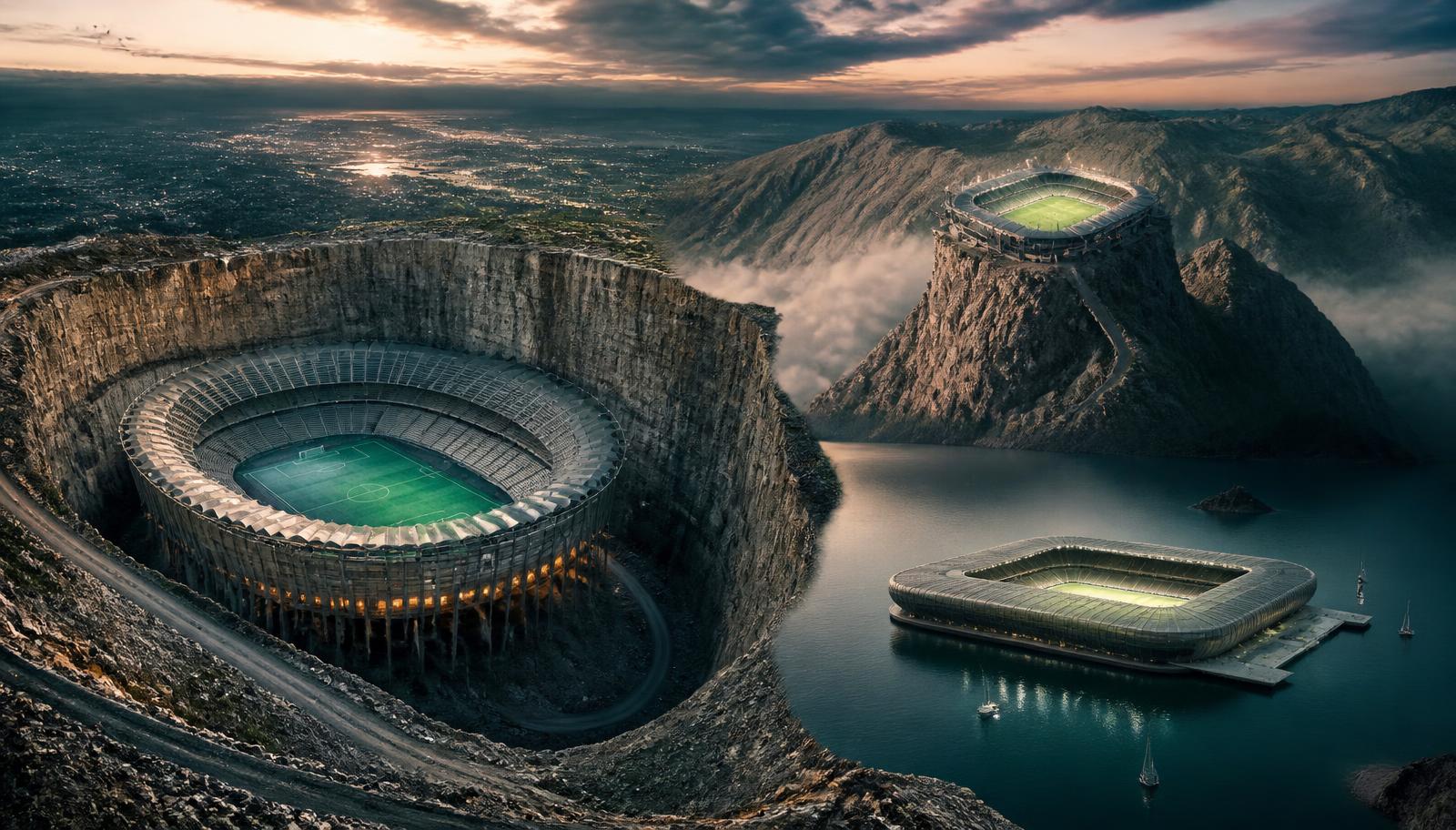
Most modern stadiums look alike: an oval bowl, four stands and a ring of boxes. Every now and then, though, the terrain, the budget or sheer stubbornness produces something unrepeatable. These ten grounds are neither the biggest nor the most expensive; they are the ones that make you look twice at the photo to believe football is actually played there.
1.Estádio Municipal de Braga
Braga, Portugal · 30,286 seats · 2003

Eduardo Souto de Moura carved a granite quarry out of Monte Castro and kept only two side stands, joined by steel cables in the style of Inca bridges. Behind one goal there is a raw rock face; behind the other, the open Braga valley. It is the only stadium in the world that feels more like sculpture than building.
2.The Float at Marina Bay
Singapore · 30,000 spectators · Floating pitch

The pitch is a 120-by-83-metre steel platform floating on the bay; the stand sits on dry land, facing the skyline. It holds 1,070 tonnes, has hosted national parades and Youth Olympic Games, and any ball that goes out of play ends up in the sea.
3.Ottmar Hitzfeld Arena
Gspon, Switzerland · 2,000 m above sea level

Europe's highest pitch is reachable only by cable car and is bordered on three sides by a sheer drop. A giant net stops balls from falling 800 metres into the Rhône valley; even so, the club budgets for lost balls every season.
4.Henningsvær Stadion
Lofoten Islands, Norway · No stands · Arctic Circle

An artificial pitch wedged between bare rock and the Norwegian Sea, with cod-drying racks as the only stand. There are no seats and no scoreboard: the aerial photograph turned it into the most viral pitch on earth and an argument for football without architecture.
5.Estádio Janguito Malucelli
Curitiba, Brazil · Brazil's first eco-stadium

Not a single tonne of concrete: the terraces are stepped earth banks held by reforested timber beams. When the club stops using it, the site simply becomes a hillside again. Radical sustainability decades before it became a selling point.
6.Stadion Gospin Dolac
Imotski, Croatia · On the edge of the Blue Lake
Built on the lip of a karst canyon, next to a 500-metre-deep sinkhole lake and beneath the ruins of a medieval fortress. It is probably the most vertigo-inducing setting in European football, and a logistical nightmare for the kit manager.
7.Estadio Hernando Siles
La Paz, Bolivia · 3,637 m above sea level

It is not odd in shape but in air: at 3,637 metres the ball flies differently and visiting benches keep oxygen tanks on hand. FIFA tried to ban it in 2007 and had to back down under pressure from half of South America.
8.Sapporo Dome
Sapporo, Japan · 8,300-tonne sliding pitch

The natural turf grows outside in the sun on an 8,300-tonne tray that glides in on a cushion of air for football matches; for baseball the tray slides out and the artificial surface appears. It took twenty years for anyone to copy it.
9.Tropicana Field
St. Petersburg, United States · Slanted roof with in-play catwalks

The last fixed dome in Major League Baseball has a slanted roof designed to resist hurricanes and four suspended catwalks that are officially part of the field of play, with their own ground rules. In 2024 Hurricane Milton tore away much of the fabric roof.
See stadium guide →10.Signal Iduna Park
Dortmund, Germany · Yellow Wall: 24,454 standing

Strange by scale rather than design: the South Stand is the largest standing terrace in European football and empties and fills like a single organism. For international fixtures it converts to seats, and the stadium loses 15,000 places and much of its soul.
See stadium guide →One thing is clear from this list: what makes a stadium memorable is almost never its capacity. It is the quarry, the cliff, the altitude or the terrace that breathes. If you have been to any of these, mark it as visited on Staddius and tell the story in your review.